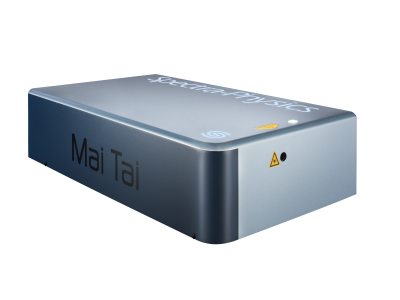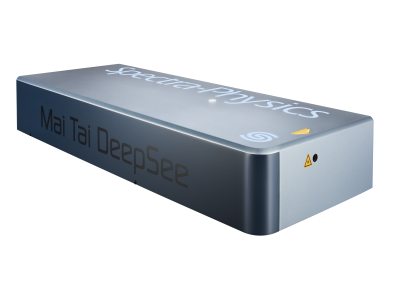
Mai Tai® DeepSee™ One Box Ultrafast Lasers
Mai Tai® DeepSee™ One Box Ultrafast Lasers
Ultrafast Ti:Sapphire Lasers with Automated Dispersion Compensation
- Delivers the highest peak power to the sample
- Wide tuning range for efficient excitation of commonly used fluorophores
- Fully automated
- Excellent beam and pointing stability to preserve the critical microscope alignment 모든 기능 보기
Applications
- Bio-Imaging
- Two-Photon Fluorescence Microscopy (2PF)
- Second Harmonic Generation Microscopy (SHG)
- Multimodal microscopy
- Terahertz imaging
- Ultrafast Spectroscopy
- Time-resolved spectroscopy
- Non-linear spectroscopy
- Semiconductor Metrology
- Laser Material Processing
- Amplifier seeding
사양
General Characteristics1, 12
| Mai Tai eHP DS | Mai Tai HP DS | Mai Tai BB DS | Mai Tai XF-1 DS | |
|---|---|---|---|---|
| Peak Power2 | >425 kW | >266 kW | >211 kW | >145 kW |
| Pulse Width2, 3, 9 | <70 fs | <100 fs | <80 fs | <70 fs |
| Tuning Range4 | 690-1040 nm | 690-1040 nm | 710-990 nm | 710-920 nm |
| Average Power2 | >2.4 W | >2.1 W | >1.35 W | >800 mW |
| Peak Power, Alternative Wavelengths5 | >56 kW at 690 nm >217 kW at 710 nm >217 kW at 920 nm >34 kW at 1040 nm |
>56 kW at 690 nm >150 kW at 710 nm >150 kW at 920 nm >34 kW at 1040 nm |
>91 kW at 710 nm >91 kW at 920 nm >35 kW at 990 nm |
>64 kW at 710 nm >64 kW at 920 nm |
| Beam Roundness2 | 0.9-1.1 | |||
| Astigmatism2 | <25% | |||
| Repetition Rate2, 6 | 80 MHz ±1 MHz | |||
| Beam Pointing Stability | <50 µrad/100 nm | |||
| Noise2, 7 | <0.15% | |||
| Stability8 | <±1% | |||
| Spatial Mode2 | TEMoo, M2 <1.1 | |||
| Polarization2 | >500:1 horizontal | |||
| Beam Divergence2 | <1.2 mrad | |||
| Beam Diameter (1/e2)2 | <1.2 mm | |||
| Standard Dispersion Compensation Range10 | 690 nm: -22,500 fs2 to -41,700 fs2 800 nm: -8,900 fs2 to -24,500 fs2 1040 nm: 0 fs2 to -9,600 fs2 |
|||
Physical Characteristics
| Mai Tai eHP DS | Mai Tai HP DS | Mai Tai BB DS | Mai Tai XF-1 DS | |
|---|---|---|---|---|
| Size (L x W x H) | 35.44 x 13.79 x 5.78 in (90.02 x 35.03 x 14.68 cm) | |||
| Weight | 106 lbs (48 kg) | |||
| Umbilical Length | 10 ft (3 m) | |||
Utility Requirements
| Mai Tai eHP DS | Mai Tai HP DS | Mai Tai BB DS | Mai Tai XF-1 DS | |
|---|---|---|---|---|
| Voltage | 110 VAC ±10% / 220 VAC ±10% | |||
| Current | Power Supply and Closed-loop Chiller: <10 A/<6 A | |||
| Frequency | 60 Hz/50 Hz | |||
Environmental Requirements11
| Mai Tai eHP DS | Mai Tai HP DS | Mai Tai BB DS | Mai Tai XF-1 DS | |
|---|---|---|---|---|
| Altitude | Up to 2000 m | |||
| Temperature, Operating | 20-25°C | |||
| Relative Humidity, Operating | Maximum 75% non-condensing up to 25°C | |||
| Temperature, Storage | 15-35°C | |||
| Relative Humidity, Storage | <65% for 15-35°C | |||
| Cooled Water Temperature in Closed-loop Chiller | 21°C typical11 | |||
Footnotes:
- Due to our continuous product improvement program, specifications may change without notice.
- Specification applies to 800 nm only.
- A sech2 pulse shape is used to determine the pulse width as measured with a Newport PulseScout® autocorrelator.
- Mai Tai is also available with a fixed, factory preset wavelength within the wavelength range noted.
- Specifications apply to operation at the wavelength noted.
- Laser operation is specified at a nominal repetition rate of 80 MHz.
- Specification represents rms noise measured in a 10 Hz to 10 MHz bandwidth.
- Percent power drift in any 2-hour period with <±1°C temperature change after a 1-hour warm up.
- Measured after external pulse compression, or measured at the sample on a system configured with the DeepSee.
- For optional range down to 0 fs2, contact Spectra-Physics.
- Avoid obstructing the air exhaust grills which will result in the recirculation of hot exhaust air. Cooling air enters th rough the front panel and exits through the rear fan apertures.
- The Mai Tai DeepSee is a Class IV - High-Power Laser, whose beam is, by definition, a safety and fire hazard. Take precautions to prevent exposure to direct and reflected beams. Diffuse as well as specular reflections can cause severe skin or eye damage.
- TypeFemtosecond Laser
- Wavelength RegionTunable
- Power800-2400 mW (ave.)
- 펄스폭fs
- Wavelength690-1040 nm
- ApplicationTime Resolved Spectroscopy
- Process TypeSpectroscopy
- ProcessOptical Coherence Tomography
기능
Overview
The Mai Tai® DeepSee™ Ti:Sapphire oscillator with our patented automated dispersion compensation1 has been specifically optimized for use in multiphoton microscopy. The Mai Tai DeepSee laser delivers the industry’s highest peak power to the sample thus maximizing the fluorescence signal. In addition, it offers over 2.4 W of average power and 350 nm (690-1040 nm) in useable tuning range.
Exceptional Stability and Versatility
The Mai Tai DeepSee oscillator’s reliability is maintained through the ultra-stable regenerative mode locking technique developed by Spectra-Physics. With hands free, drop-out free wavelength tuning, excitation profiles can be quickly collected with just the click of a mouse. StabiLok® real-time monitoring technology also enhances system reliability by providing excellent beam pointing stability and minimal average power fluctuations, as well as eliminating wavelength drift. These two features make the Mai Tai DeepSee oscillator the most reliable and most versatile hands-free laser currently on the market.
Integrated Dispersion Pre-Compensation for Deep Tissue Imaging
With the Mai Tai DeepSee oscillator, deeper penetration depths can be achieved without the risk of sample
damage from increased average powers. When ultrafast laser pulses are transmitted through optical materials (i.e. windows, lenses, and nonlinear crystals), the added dispersion broadens the pulse. This pulse broadening has a negative affect on the fluorescence signal obtained. The Mai Tai DeepSee option corrects in advance for the optical setup dispersion through pre-compensation, which maximizes the observed fluorescence signals. Sample damage could prevent the average power from being increased. For these cases, high peak power is the most effective way to increase the fluorescence.
호환 가능한 파워 센서
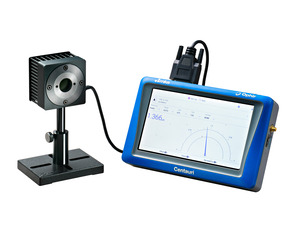
Mai Tai DeepSee 레이저의 출력 확인과 분석은, Ophir 3A (7Z02621) 열 전력 센서와 Centauri 레이저 파워 미터를 추천합니다. 이 레이저 측정 장비에 대한 추가 정보는 ophiropt.com 에서 웹사이틍서 찾아 볼 수 있습니다. 다른 Ophir 센서와 미터기도 용도에 따라 Mai Tai DeepSee 에 적합할 수 있습니다. 또한 Ophir는 레이저 시스템 개발자들과의 협력을 통해 임베디드 빔 진단법을 구축하여, OEM 솔루션으로서 시스템 성능을 모니터합니다.
리소스
Technical Articles
Multiphoton Microscopy Provides a Deeper View of the Aging Brain(2 MB, PDF) 뇌졸증의 충격을 포착하는 NIR 분광법(2.4 MB, PDF)
Application Notes
다른 다중 모드 이미징 기술을 보완하는 CARS 이미징(884.6 kB, PDF) 다광자 이미징
Data Sheets
MaiTai DeepSee Datasheet(814.6 kB, PDF)
Drawings & CAD
Mai Tai DeepSee Dimensions(209.2 kB, PDF)
사전 설치 가이드
Mai Tai 그리고 Mai Tai DeepSee 사전 설치 가이드(288.6 kB, PDF) Ultrafast 사전 설치 가이드(213.7 kB, PDF)
Literature
Ultrafast Lasers Brochure(4.6 MB, PDF)