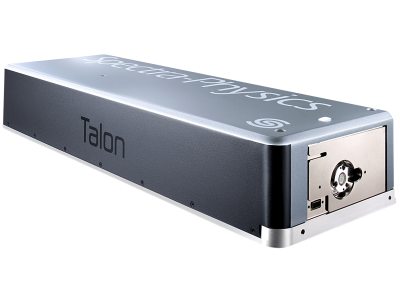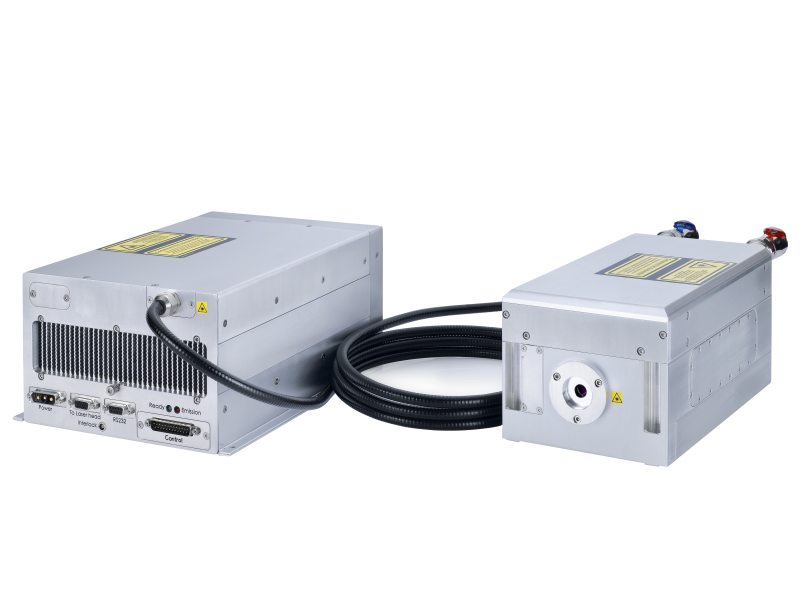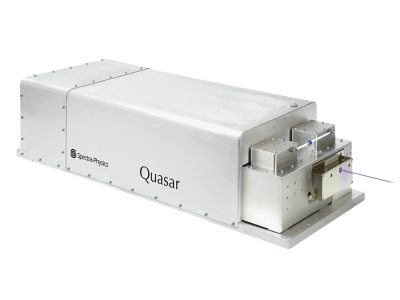
Quasar® High Power Hybrid Fiber Lasers
Quasar® High Power Hybrid Fiber Lasers
High Power UV & Green Hybrid Fiber Lasers for Fast Precision Micromachining
- >80 W UV (400 μJ) or >60 W UV (300 μJ)
- >95 W Green (475 μJ) or >75 W Green (375 μJ)
- TimeShift Technology
- High repetition rates from 0–3.5 MHz for fast processing See All Features
Applications
Specifications
Specifications1,2,5
| Quasar UV80 | Quasar UV60 | Quasar UV60-Turbo |
Quasar UV45 | Quasar GR95 | Quasar GR75 | |
|---|---|---|---|---|---|---|
| Wavelength | 355 nm | 355 nm | 355 nm | 355 nm | 532 nm | 532 nm |
| Output Power | >80 W @ 200 kHz, 10 ns | >60 W @ 200 kHz, 10 ns >60 W @ 300 kHz, 10 ns |
>38 W @ 3 MHz, 2 ns | >45 W @ 200 kHz, 10 ns >45 W @ 250 kHz, 10 ns >41 W @ 300 kHz, 10 ns |
>95 W @ 200 kHz, 10 ns | >75 W @ 200 kHz, 10 ns |
| Maximum Pulse Energy or Burst Energy | >400 µJ (pulse) | >300 µJ (pulse) | >12 µJ (pulse) | >225 µJ (pulse) | >475 µJ | >375 µJ |
| Repetition Rate Range | 0–3.5 MHz | 0–3.5 MHz | 0–3.5 MHz | 0–1.7 MHz | 0–3.5 MHz | 0–1.7 MHz |
| Optimized TimeShift™ Setting (Nominal setup for beam optimization) |
200 kHz, 10 ns | 300 kHz, 10 ns | 3 MHz, 2 ns | 300 kHz, 10 ns | 200 kHz, 10 ns | |
| Pulse-to-Pulse Stability | <5%, 1s | |||||
| Power Stability (after warm-up) | <2%, 1σ, over 8 hours | |||||
| Beam Pointing Stability | <±25 µrad/°C | |||||
| Peak Stability (Peak to Peak) (after warm-up) | ±3% over 8 hours | |||||
| Polarization | 100:1, vertical | 100:1, horizontal | ||||
| Spatial Mode | TEM00 (M2 <1.3) | |||||
| Beam Divergence, full angle | <0.3 mrad | <0.45 mrad | ||||
| Beam Asymmetry | <1.10 | |||||
| Pulse Width, FWHM (TimeShift programmable)3 | <2 ns to >100 ns | <5 ns to >100 ns | <2 ns to >100 ns | <5 ns to >100 ns | ||
| Beam Diameter (D4s) | 3.5 ±0.35 mm | |||||
| Boresight Tolerance | ±0.5 mm ±5 mrad |
|||||
Operating Conditions
| Quasar UV80 | Quasar UV60 | Quasar UV60-Turbo |
Quasar UV45 | Quasar GR95 | Quasar GR75 | |
|---|---|---|---|---|---|---|
| Warm-up Time, typical | <40 min Electrical ON, Diodes OFF; <60 min from Electrical ON, Diodes OFF |
|||||
| Temperature Range | 15–35°C | |||||
| Altitude | 0–2000 m | |||||
| Humidity | 10–80% non-condensing | |||||
Storage Conditions
| Quasar UV80 | Quasar UV60 | Quasar UV60-Turbo |
Quasar UV45 | Quasar GR95 | Quasar GR75 | |
|---|---|---|---|---|---|---|
| Temperature Range | 0–50°C | |||||
| Altitude | 0–10,000 m | |||||
| Humidity | 10–80% non-condensing | |||||
Electrical and Chiller Requirements
| Quasar UV80 | Quasar UV60 | Quasar UV60-Turbo |
Quasar UV45 | Quasar GR95 | Quasar GR75 | |
|---|---|---|---|---|---|---|
| Heat Load (at laser head) | <1900 W | <1500 W | ||||
| Water Temperature (laser inlet) | 20°C ±1°C | |||||
| Water Temperature Stability | ±0.5°C | |||||
| Water Flow Rate (at laser head) | ≥9.5 l/min | |||||
| Power Input | 190–240 VAC, 2500 Watts Maximum, 50/60 Hz, single phase | |||||
| Heat Load (at power supply) | <500 W | <400 W | ||||
| Power Consumption | <2400 W | <1900 W | ||||
Physical Characteristics
| Quasar UV80 | Quasar UV60 | Quasar UV60-Turbo |
Quasar UV45 | Quasar GR95 | Quasar GR75 | |
|---|---|---|---|---|---|---|
| Laser Head Dimensions (L x W x H)4 | 39.4 x 14.7 x 9.3 in (1000 x 373 x 235 mm) | |||||
| Laser Head Weight | 200 lbs (90 kg) | |||||
| Power Supply Dimensions (L x W x H) | 21.1 x 19.0 x 6.9 in (536 x 483 x 176 mm) | |||||
| Power Supply Weight | 35 lbs (16 kg) | |||||
| Cable Length | 5 m | |||||
Other
| Quasar UV80 | Quasar UV60 | Quasar UV60-Turbo |
Quasar UV45 | Quasar GR95 | Quasar GR75 | |
|---|---|---|---|---|---|---|
| Complies with EU Directive 2015/863/EU; China RoHS2 GB/T 26572---2011 and SJ/T11364---2014 |
Yes | |||||
| User Replaceable Output Window | Yes | |||||
| Optional Safety Shutter | Yes | |||||
| Data Log (includes customer version as well) | Long and short term recording for diagnostics and equipment maintenance | |||||
Footnotes for UV Lasers:
- Due to our continuous product improvement program, specifications may change without notice.
- Quasar UV80 nm test specs are at 10 ns at 200 kHz with the diode current set to achieve 81 W. Quasar UV60 and UV45 nm test specs are at 10 ns at 300 kHz with the diode current set to achieve 62 W for the Quasar UV60, and 42 W for the UV45. Quasar UV60-Turbo test specs are at 3 MHz 2 ns with diode current set to achieve 40 W.
- Quasar UV80, UV60 and UV45: nominal pulse width 10 ns. Quasar UV60-Turbo nominal and pulse width is 2 ns. Alternative/programmable pulse widths using TimeShift will change power and beam parameter performance. Contact Spectra-Physics for more information.
- Quasar UV80, UV60, UV60-Turbo and UV45 dimensions noted do not include the standard removable lifting hoist exoskeleton or the optionally removable lift handles.
- Quasar is a Class IV - High Power Laser, whose beam is, by definition, a safety and fire hazard. Take precautions to prevent exposure to the direct and reflected beams. Diffuse as well as specular reflections can cause severe skin or eye damage.
Footnotes for Green Lasers:
- Due to our continuous product improvement program, specifications may change without notice.
- All green wavelength test specs are at 10 ns at 200 kHz with the diode current set to achieve 97 Watts for the Quasar GR95 and 77 Watts for the GR75.
- Quasar GR95 and GR75: nominal pulse width is 10 ns.
- Quasar GR95 and GR75 dimensions noted do not include the standard removable lifting hoist exoskeleton or the optionally removable lift handles.
- Quasar is a Class IV - High Power Laser, whose beam is, by definition, a safety and fire hazard. Take precautions to prevent exposure to the direct and reflected beams. Diffuse as well as specular reflections can cause severe skin or eye damage.
- TypeFiber Laser
- Pulse Energy>225 µJ
>375 µJ - Wavelength RegionVIS
- Power45-60 W (355 nm)
>75 W (532 nm) - Pulse Widthns
- Wavelength355 nm
532 nm - ApplicationPCB Manufacturing
- Process TypeDoping
- ProcessThrough-silicon Via Drilling
Features
Overview
The Quasar series is an industry leader with high UV average power and energy at high rep rate for fast
micromachining. Quasar features novel TimeShift™ technology for programmable pulse profiles for the
ultimate in process speed, flexibility, and control.
Industry Leading Technology
Quasar combines advanced fiber laser, power amplifier and patented harmonics technologies to achieve industry leading results. This unique design exploits fiber laser flexibility and robustness to enable
TimeShift technology. Adding Spectra-Physics’ exclusive power amplifier, Quasar enhances this
flexibility at high output power levels. Finally, with Spectra-Physics’ patented harmonics, known for
exceptional stability, Quasar continues to provide an innovative synergy of power, flexibility and control
in a reliable 24/7 OEM laser for the most demanding applications.
Industry Leading Performance
The Quasar UV80 produces >80 W of UV output power at specification point 200 kHz 10 ns and >400 µJ pulse energy, complementing Spectra-Physics’ breakthrough Quasar UV45, UV60 and UV60-Turbo lasers. The Quasar UV80 operates over a wide repetition rate range from 0–3.5 MHz, with pulse widths from <2 ns to >100 ns. The Quasar UV60 produces >60 W of UV output power at specification point 300 kHz 10 ns. The Quasar UV60-Turbo, optimized for high repetition rate performance, produces >38 W of UV output power at specification point 3 MHz 2 ns. The Quasar UV60-Turbo is an excellent match for high speed polygon scanning systems. The Quasar GR95 produces >95 W of green output power, with similar pulse width and PRF range as the Quasar UV60, complementing Spectra-Physics’ breakthrough Quasar UV45 laser.
Reliable Continuous Operation
Quasar is designed, built, and tested to stringent quality standards for reliable continuous operation in demanding 24/7 manufacturing environments. The built-in ALPS (Active Laser Purification System) helps sustain that performance for long life. And finally, Quasar lasers' automatic data logging software monitors all key laser performance parameters over the life of the laser, providing a powerful service feature and product reliability tool. A customer version of this software is also available.
TimeShift Technology
Quasar is the first laser of this class to offer TimeShift technology, which enables pulse energy programmability in the time domain. By controlling the laser pulse (width and shape) in time and repetition rate, material removal and/or modification in micromachining becomes more efficient, thereby increasing process speed and quality. Utilizing TimeShift in conjunction with high UV or green power at a higher repetition rate means Quasar can process more materials faster, and with greater quality. TimeShift enables pulse width variation, as well as pulse splitting and burst mode operation. For the Quasar UV80, UV60, UV60-Turbo and GR95 models, pulse widths from <2 ns to >100 ns can be created at a constant repetition rate or conversely, maintain constant pulse width with varying repetition rate from 0 to 3.5 MHz. A set of standard TimeShift waveforms is provided with each Quasar. The TimeShift GUI, which enables users to develop custom waveforms, is available at an additional cost.
- TimeShift Constant Pulse Width vs Pulse Repetition Frequencies (PRF): Unlike conventional Q-switched lasers, Quasar’s TimeShift technology can maintain constant pulse width over a wide range of repetition rates or pulse repetition frequencies (PRF). Constant pulse width means the peak power remains more constant, allowing for more consistent process results at higher speeds.
- TimeShift Variable Pulse Width and Pulse Shaping: Varying the pulse width for a given PRF can be used to optimize the material interaction. By changing the energy and intensity within a pulse (pulse shaping), the heating or cooling of the material is further optimized.
- TimeShift Pulse Splitting and Burst Mode: By splitting the pulses at a given PRF, the material is allowed to dissipate the heat or plasma such that more efficient material removal is possible. By altering the number, spacing, and relativity intensity of pulses within the burst, the spatial-temporal thermal profile in the work piece can be precisely tailored, increasing process speed and/or quality.
Compatible Power Sensors
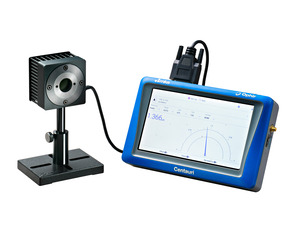
To verify and analyze the output power of your Quasar laser, we recommend the Ophir F80(120)A-CM-17 (7Z07103) or F150(200)A-CM-16 (7Z07107) thermal power sensor and Centauri laser power meter. Additional information on this laser measurement equipment can be found on the ophiropt.com website. Other Ophir sensors and meters may also be suitable for the Quasar depending on application. Ophir also works with laser system developers to achieve embedded beam diagnostics to monitor system performance as an OEM solution.
Recommended Optics & Optomechanics
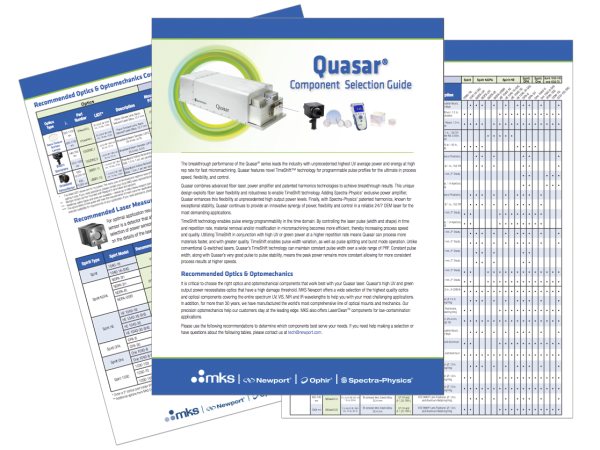
It is critical to choose the right optics and optomechanical components that work best with your Quasar laser. Quasar’s high UV and green output power necessitates optics that have a high damage threshold. MKS Newport offers a wide selection of the highest quality optics and optical components covering the entire spectrum UV, VIS, NIR and IR wavelengths to help you with your most challenging applications.
Resources
Technical Articles
Hybrid Fiber Lasers Create New Capabilities for Micromachining Hybrid Fiber Lasers Raise the Bar for Precision Manufacturing(288.1 kB, PDF) Nano to Pico to Femto: Pulse Widths for Optimal Laser Micromachining Outcomes Pulse Tailoring with UV Laser Source Improves Throughput and Quality for High-Density Packaging Glass Interposer Drilling(1.3 MB, PDF) Laser Machining of CFRP(1 MB, PDF) Doubling Silicon Ablation Process Efficiency and Improving Quality Using High Power High Repetition Rate Green Laser with TimeShift Capability(1.7 MB, PDF) Laser Scribing: A Key Enabling Technology for Manufacturing of Low Cost Thin Film Photovoltaic Cells(876.3 kB, PDF)
Data Sheets
Quasar Datasheet(1.1 MB, PDF)
Selection Guides
Quasar Component Selection Guide(1,006.1 kB, PDF)
Drawings & CAD
Quasar Dimensions(587.3 kB, PDF)
Pre-installation Guides
Quasar® Pre-installation Guide(1.3 MB, PDF)
Application Notes
Cutting 5G Flex PCB Materials with a High Energy, High Power Nanosecond UV Laser(1 MB, PDF) High Speed Processing of Plastics with a 100 W fs Laser(468.5 kB, PDF) Li-ion Battery Foil Cutting Using Pulsed Green Lasers(526.9 kB, PDF) UV Laser Texturing of CFRP(479.3 kB, PDF) High Quality Li-ion Battery Cell Manufacturing(439 kB, PDF) Through-Glass Via Drilling with a UV Laser Source(467.1 kB, PDF) Industrial PERC Solar Cell Processing(464.1 kB, PDF) CFRP Machining Using Pulsed UV Lasers(329.5 kB, PDF) High Quality Precision Micromachining at 50 m/sec Scanning Speed(254.7 kB, PDF) Glass Cutting and Silicon Scribing Excel with Quasar® TimeShift™ Technology(287.8 kB, PDF) Cutting 5G Flex PCB Materials with a High Energy, High Power Nanosecond UV Laser(1 MB, PDF)